Evaluating Cactus Wall Decor Laser Cut SVG Files for Precision Crafting
For makers and small business owners specializing in home decor, the choice of digital assets is as critical as the machinery used to produce them. When exploring options for botanical-themed interior accents, a Cactus Wall Decor Laser Cut SVG often emerges as a top contender. However, not all vector files are created equal. Understanding the specific architectural nuances of these designs—particularly regarding connectivity, path cleanliness, and material adaptability—is essential for achieving professional results without excessive post-processing.
This analysis breaks down what distinguishes high-quality cactus vector designs from generic alternatives, helping you evaluate whether this specific format aligns with your production workflow and aesthetic goals.
The Importance of Fully Connected Structures
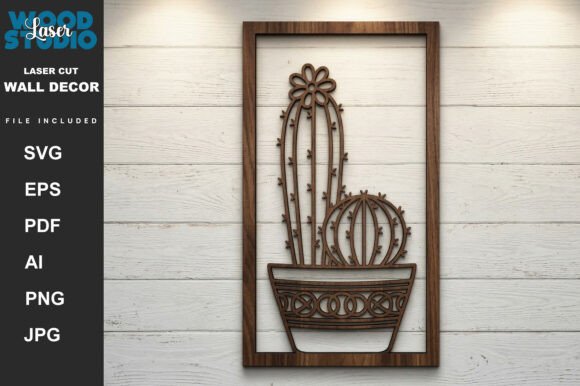
The primary differentiator in a premium Cactus Wall Decor Laser Cut SVG is its structural integrity. In laser cutting, particularly with materials like wood, MDF, or acrylic, the concept of "floating elements" presents a significant challenge. Many lower-quality vector files depict cactus arms or floral details as separate entities that are not physically connected to the main body. While this looks acceptable on a screen, it creates logistical issues during the cutting process.
When a design lacks a fully connected layout, the inner pieces can fall into the honeycomb bed of the laser cutter or shift during the operation, leading to misalignment and ruined materials. A superior Cactus Wall Decor Laser Cut SVG utilizes bridge techniques or integrated pathways to ensure every element remains part of a single, cohesive unit. This "monolithic" approach ensures that once the machine finishes its job, the piece lifts out intact, requiring no manual gluing or reassembly. For producers aiming for efficiency, this feature alone can reduce finishing time by nearly 50%.
Material Versatility and Cut Quality
One of the strengths of a well-engineered cactus SVG is its adaptability across various substrates. Whether you are working with 3mm plywood for a rustic look, cast acrylic for a modern glossy finish, or even leather for textured wall hangings, the vector paths must be optimized for clean entry and exit points.
Designs featuring smooth cutting structures minimize burn marks and jagged edges. This is particularly important when working with darker woods or colored acrylics, where imperfections are highly visible. A robust file allows for easy resizing without distorting the line weight, ensuring that the design remains viable whether you are creating a small desk accent or a large statement piece for a living room wall. The ability to scale the Cactus Wall Decor Laser Cut SVG while maintaining path precision is a key factor in its utility for diverse product lines.
Comparing Vector Formats: SVG vs. Alternatives
When sourcing digital designs, creators often encounter a variety of file formats. Understanding why the SVG format is frequently preferred over others can influence your purchasing or creation decisions.
- SVG (Scalable Vector Graphics): This is the industry standard for laser cutting software like LightBurn and many CNC interfaces. It preserves mathematical paths, allowing for infinite scaling without pixelation. A dedicated Cactus Wall Decor Laser Cut SVG ensures compatibility across almost all cutting platforms.
- DXF (Drawing Exchange Format): Often used in CAD-heavy environments. While functional, DXF files sometimes introduce unnecessary nodes or convert curves into short line segments, which can result in slightly rougher cut edges compared to a native SVG.
- PNG/JPG Raster Images: These are pixel-based and generally unsuitable for direct cutting unless traced first. Tracing raster images often introduces errors in the vector paths, leading to uneven cuts. Relying on a pre-converted SVG eliminates this variable.
- AI/EPS Files: These are excellent for editing in Adobe Illustrator but may require conversion before being sent to the laser cutter. Having access to these alongside the SVG provides flexibility for customization, but the SVG remains the workhorse for production.
The inclusion of multiple formats—such as AI, EPS, PDF, and PNG—alongside the main SVG file adds significant value. It allows the user to edit the source if necessary (e.g., adding a custom name or altering the pot design) while retaining a ready-to-cut file for immediate production.
Trade-offs and Limitations
While a Cactus Wall Decor Laser Cut SVG offers numerous advantages, it is not the universal solution for every project scenario. Recognizing its limitations helps in making an informed choice.
Complexity vs. Durability: Highly intricate cactus designs with very fine spines or delicate flower petals may be fragile when cut from thin materials like 3mm MDF. In such cases, a simpler silhouette style might be more durable for shipping or high-traffic areas. If your target market requires rugged durability, you may need to modify the SVG to thicken certain stress points or choose a different design archetype altogether.
2D vs. 3D Assembly: Most standard cactus SVGs are designed for single-layer flat cutting. If your goal is to create a 3D freestanding cactus, a flat SVG is insufficient unless it is specifically engineered with slots for interlocking layers. Buyers must verify if the file is intended for wall mounting (2D) or structural assembly (3D). Using a wall-decor SVG for a 3D project will result in a failed build without significant modification.
Customization Requirements: Although these files are editable, users without experience in vector software (like Inkscape or Illustrator) may find it challenging to alter the design significantly. For those who need frequent, drastic variations, a parametric design tool or a custom commission might be a better investment than a static SVG file.
Decision Factors for Selecting the Right Design
To determine if a specific Cactus Wall Decor Laser Cut SVG is the right resource for your needs, consider the following evaluation criteria:
- Path Inspection: Before cutting, open the file in your vector software and zoom in on the joints. Are there gaps? Are the lines truly connected? A high-quality file will show no loose endpoints.
- Machine Compatibility: Ensure the file units (inches vs. millimeters) match your machine's settings to avoid sizing errors. Most professional SVGs are unit-agnostic but should be checked upon import.
- End-Use Application: Are you selling these as finished goods or as DIY kits? If selling finished goods, a fully connected design reduces labor costs. If selling kits, ensure the design is simple enough for end-users to assemble if required.
- Licensing Terms: Always review the license associated with the digital download. Some files are for personal use only, while others allow for unlimited commercial production. This legal aspect is just as important as the technical specifications.
Practical Applications and Market Fit
The versatility of the cactus motif makes it a perennial favorite in home decor. A well-executed Cactus Wall Decor Laser Cut SVG can be adapted for nursery art, bohemian living room accents, or even outdoor garden signage if cut from weather-resistant materials like HDPE or treated acrylic.
For educators and workshop leaders, these files serve as excellent teaching tools. The clear paths and recognizable shapes make them ideal for introducing students to the basics of laser cutting parameters, such as speed and power settings, without the frustration of complex, failing cuts.
Ultimately, the decision to utilize a specific cactus SVG comes down to the balance between aesthetic desire and production reality. By prioritizing files with clean vector paths, fully connected structures, and broad format compatibility, creators can streamline their workflow and elevate the quality of their final output. While alternative methods exist, the precision and repeatability offered by a professionally crafted Cactus Wall Decor Laser Cut SVG make it a cornerstone asset for serious laser cutting enthusiasts and businesses alike.